
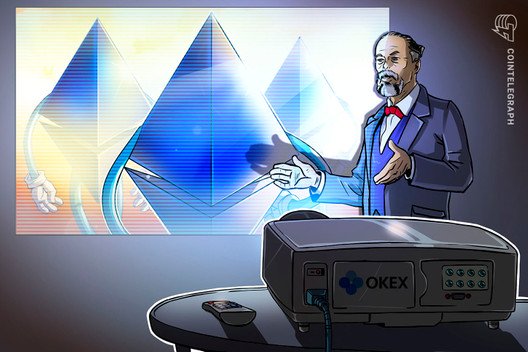

OkEx joins ETH 2.0 Topaz testnet as a validator, as multiple companies race to develop a Phase 0 client before end of 2020.
OkEx Pool, the staking arm of the OkEx conglomerate, announced that it has joined an Ethereum 2.0 testnet as a Proof-of-Stake validator.
As revealed by its April 29 blog entry, OkEx is now validating blocks in the Ethereum 2.0 Topaz testnet, launched by Prysmatic Labs. Alysa Xu, the chief strategy officer for OkEx, said that the exchange believes in the potential of Ethereum and its role in the industry.
In addition, she revealed that the exchange is planning to promote Ethereum development after having “already established the collaboration with Prysmatic Labs.”
Prysmatic Labs is one of several companies that are working on a client for Ethereum 2.0.
Independent Testnets
For Ethereum 2.0, the Ethereum Foundation is allowing many independent projects to come up with their own clients. This is the software that defines how a blockchain operates, and it is important that all implementations remain compatible with each other.
The Topaz testnet is a new iteration of Prysmatic Labs’ testing environment, launched on April 16. It replaced the previous version launched in 2019, called Sapphire. One of the most impactful changes between the two versions is the minimum staking requirement, which was upped from 3.2 ETH to the full 32 ETH.
To access the Topaz testnet, one needs to deposit ETH on the Goerli testnet, which is running standard Ethereum 1.0. This connection is required to test one of the most critical components of Ethereum 2.0 — the deposit contract. This smart contract manages all staking activity and is a key part of the planned Ethereum Phase 0 upgrade.
As Cointelegraph reported in January, the Ethereum Foundation issued a grant to the developers of Nimbus, another Ethereum 2.0 client.
It is still unclear when Ethereum 2.0 may see an official release. Developers previously assured the community that the first phase is likely to come before the end of 2020.
Exchange validators
Proof-of-Stake systems often see exchanges dominate the block production process due to their control of user stakes.
While this was used for political purposes in the Steem takeover scandal, other blockchains seem to have a more symbiotic relationship with exchanges.
As Cointelegraph previously reported, not all exchanges allow their users to express their vote or benefit from staking — though OkEx is an exception.
Source: , CoinTelegraph

Articles listed with Cash Tech News as the author are either general information, or may have been imported from another website, to bring our readers a rich media experience that encompasses articles that we find interesting, as well as those curated by others.
The views and opinions expressed here are for informational purposes only, and should not be confused with professional financial advice. These opinions are solely those of the author and do not necessarily reflect the views of CashTechNews.com. Every investment and trade involves risk. You should conduct your own research, and contact your professional financial advisor before making any investment.
Corrections, feedback, and ideas should be submitted through the website contact form.